
Exploring Different Types of Thinking Traps or “Cognitive Distortions”
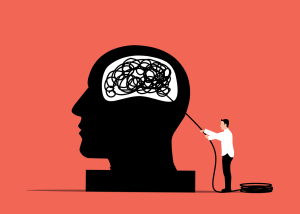 Your boss praises nine things you did well in your performance review, but offers one small piece of constructive criticism. What do you focus on for the rest of the day? If you’re like most people, you’ll be obsessing over that one negative comment. Our brains are naturally wired with a “negativity bias” that makes us pay more attention to bad things than good things. When we are struggling with anxiety or depression, this bias can get kicked into overdrive, and our thinking can become systematically skewed in a negative direction. These predictable, biased patterns of thinking are known as “cognitive distortions” or “thinking traps.”
At Televero Health, a core part of Cognitive Behavioral Therapy (CBT) is helping you to become a “thought detective.” The first step is to learn to spot these common thinking traps in your own mind. When you can name a distortion, you take away its power. You can see it for what it is—a biased interpretation, not a fact.
10 Common Thinking Traps
Here are ten of the most common cognitive distortions. See if you can recognize any of them in your own self-talk.
- All-or-Nothing Thinking (Black-and-White Thinking): You see things in absolute, black-and-white categories. If your performance falls short of perfect, you see yourself as a total failure. There is no middle ground. (e.g., “I got a B on that test. I’m a complete idiot.”)
- Overgeneralization: You see a single negative event as a never-ending pattern of defeat. You use words like “always” and “never.” (e.g., After a bad date, you think, “I’m always so awkward. I’ll never find anyone.”)
- Mental Filter: You pick out a single negative detail and dwell on it exclusively, so that your vision of all reality becomes darkened, like the drop of ink that discolors a whole beaker of water. (This is the performance review example from above.)
- Disqualifying the Positive: You reject positive experiences by insisting they “don’t count” for some reason or another. This allows you to maintain a negative belief that is contradicted by your everyday experiences. (e.g., “I only did well on that project because I got lucky.”)
- Jumping to Conclusions: You make a negative interpretation even though there are no definite facts that convincingly support your conclusion. This takes two common forms:
- Mind Reading: You arbitrarily conclude that someone is reacting negatively to you, and you don’t bother to check this out. (e.g., “He thinks I’m boring.”)
- The Fortune Teller Error: You anticipate that things will turn out badly, and you feel convinced that your prediction is an already-established fact. (e.g., “I’m going to fail this exam.”)
- Magnification (Catastrophizing) or Minimization: You exaggerate the importance of your mistakes or imperfections, or you shrink the importance of your own good qualities. (e.g., “I made a typo in that email. My career is over!”)
- Emotional Reasoning: You assume that your negative emotions necessarily reflect the way things really are. “I feel it, therefore it must be true.” (e.g., “I feel so anxious, so I must be in real danger.”)
- “Should” Statements: You try to motivate yourself with “shoulds” and “shouldn’t,” as if you had to be whipped and punished before you could be expected to do anything. This can also be directed at others. The emotional consequence is guilt or, when directed at others, frustration and resentment. (e.g., “I should exercise more.”)
- Labeling and Mislabeling: This is an extreme form of overgeneralization. Instead of describing your error, you attach a negative label to yourself: “I’m a loser.” When someone else’s behavior rubs you the wrong way, you attach a negative label to them: “He’s a jerk.”
- Personalization: You see yourself as the cause of some negative external event which in fact you were not primarily responsible for. (e.g., “It’s my fault my child is struggling in school.”)
Learning to identify these traps is the first and most powerful step in changing them. Once you can label a thought—”Oh, that’s catastrophizing”—it loses its credibility. You can see it’s just a bad mental habit, not the truth. This creates the space you need to challenge the thought and to choose a more balanced and realistic perspective.
Key Takeaways
- Cognitive distortions, or “thinking traps,” are predictable, biased patterns of thinking that can fuel anxiety and depression.
- Common traps include All-or-Nothing Thinking, Mind Reading, and Catastrophizing.
- The first step to changing these patterns is to learn to identify and label them in your own self-talk.
- Once you can recognize a thought as a distortion, you take away its power and can begin to challenge it and replace it with a more balanced view.
Ready to take the first step? We can help. Get started with Televero Health today.